November PM2.5 warnings put Bangkok air quality back in the headlines. Here is how to keep facial care gentle, read anti-pollution claims critically and choose an appointment that suits your skin.
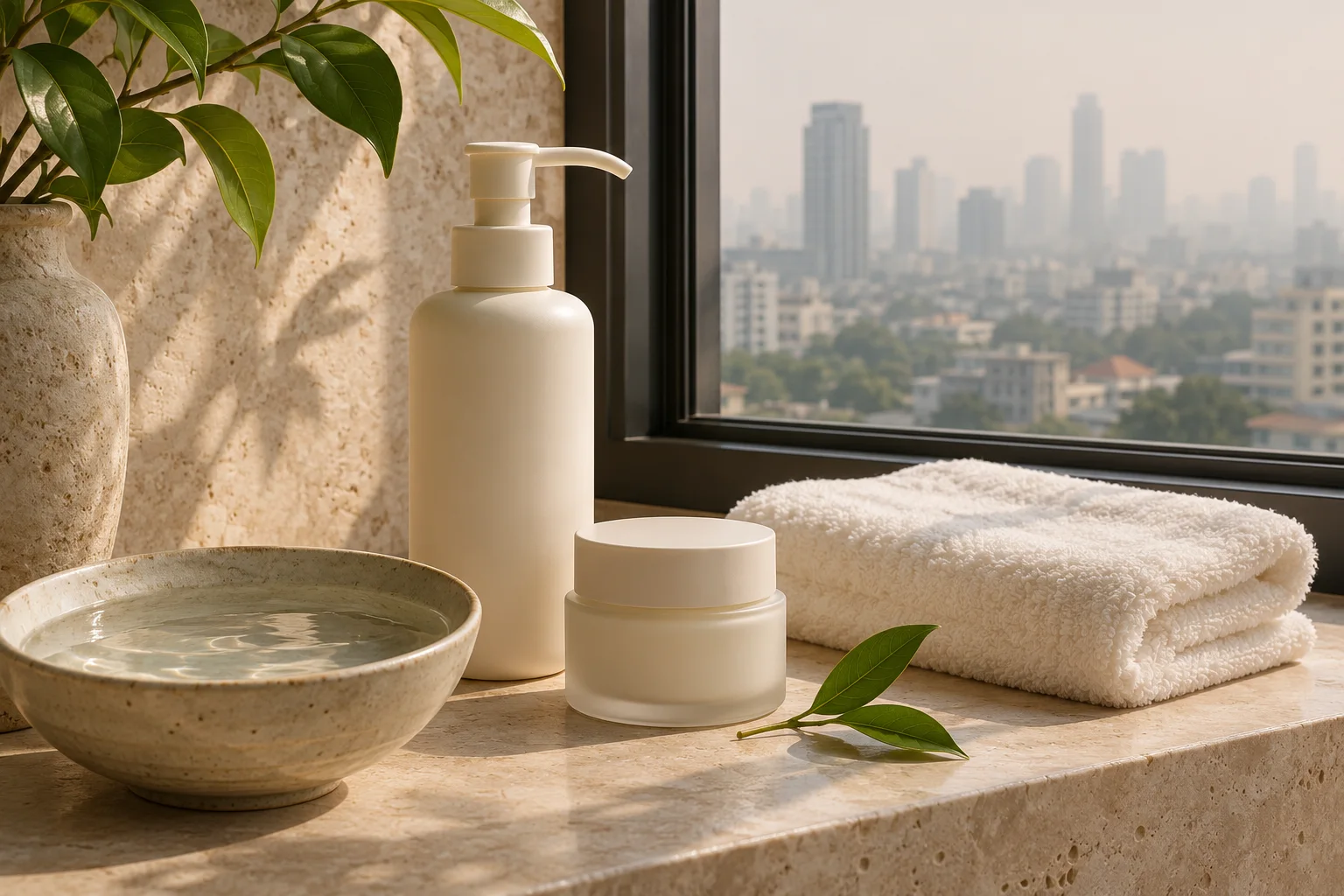
AI-generated editorial illustration for Facial Bangkok; not a photograph of current air quality, a real venue or tested products.
Why Bangkok pollution skincare matters this November
A facial booking can feel like a small decision until your skin becomes uncomfortable during a week of haze. Bangkok residents and visitors now have a timely reason to reconsider the familiar promise of a deep-cleaning “detox”. The useful goal is a comfortable face and a treatment you understand, rather than the strongest possible cleansing session.
In a 15 November 2026 report, The Nation relayed the Pollution Control Department's warning that PM2.5 could accumulate around Bangkok on 19–20 November. The report referred to nine locations exceeding the national standard in the 14 November assessment, including five Bangkok districts. These are dated observations and a forecast, not a live reading for your neighbourhood.
Check the current local advisory before planning outdoor activities or travelling across town. The World Health Organization's guidance explains that changing the timing and location of activities can reduce exposure. Skincare is a separate comfort and grooming decision: it cannot substitute for public-health precautions.
What does PM2.5 actually mean for facial skin?
PM2.5 describes fine airborne particles with an aerodynamic diameter of 2.5 micrometres or less. It is not a beauty diagnosis. You cannot identify a pollution-related skin condition from the sky's colour or prove that traffic caused a particular blemish simply because it appeared after a commute.
A 2025 review in Annals of Dermatology describes pathways linking air pollutants with oxidative stress, inflammation and disruption of skin-barrier function. It brings together laboratory mechanisms and research on skin diseases. That supports taking exposure seriously, while leaving a substantial gap between understanding a biological pathway and proving that a commercial facial prevents pollution damage.
For booking purposes, describe what you actually notice: tightness, stinging, visible flaking or a change in how familiar products feel. Avoid diagnosing yourself with “toxin buildup”. If discomfort persists, seek a qualified dermatologist's assessment. Our barrier-friendly facial guide provides consultation questions for a simpler appointment.
A simple skincare routine for polluted days in Bangkok
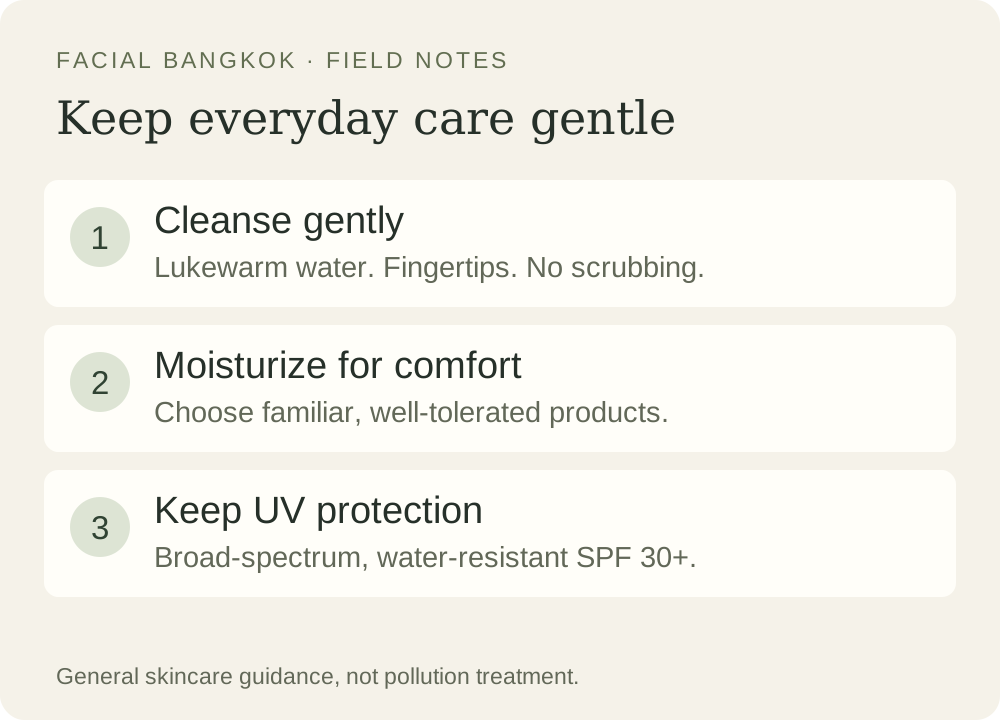
Cleanse carefully when you come home
The American Academy of Dermatology's face-washing guidance recommends a mild cleanser, lukewarm water and fingertips rather than abrasive tools. Rinse gently and pat dry. Its general advice is to wash morning and evening and after heavy sweating; a pollution alert is not a reason to scrub repeatedly.
At your hotel or bathroom sink, make the routine easy to repeat. Keep your usual cleanser accessible and follow its directions for removing makeup or sunscreen. Do not make the evening a test of several new products just because the air looked hazy. A clean-feeling face does not need to feel stripped.
Choose comfort before adding another active
For dry skin, the AAD's dry-skin recommendations favour gentle, fragrance-free care and moisturizer after washing. Apply that principle to your shopping decisions: choose a texture you tolerate, rather than a jar whose main attraction is an “urban shield” label. Ask your clinician before changing prescribed skincare.
Keep UV protection in the routine
The AAD recommends sunscreen labelled broad-spectrum, water-resistant and SPF 30 or higher. Pollution protection and sun protection are different claims. Continue following sunscreen directions and sun-safety advice instead of treating haze as a reason to skip the usual precautions.
Watch: gentle cleansing explained by dermatologists
This established AAD demonstration illustrates face-washing technique. It is general education, published in 2012, rather than a new PM2.5 study or an endorsement of a Bangkok facial provider.
Which facial in Bangkok should you consider?
Start with your skin's present condition and your reason for booking. A pleasant cosmetic appointment may be worthwhile for relaxation, cleansing or hydration. Ask the provider to describe those services directly. “Anti-pollution” alone tells you little about the actual protocol, suitability or expected result.
| Your priority | What to discuss | What to clarify |
|---|---|---|
| Comfort and hydration | A gentle, adaptable facial | Product list and optional steps |
| Congestion or visible blackheads | A consultation about cleansing | Whether extractions are appropriate |
| A device-led appointment | The exact device and protocol | Suction, exfoliation and add-ons |
| Persistent irritation | Dermatologist assessment first | Whether a cosmetic appointment should wait |
If you are comparing technology-led cleansing, our HydraFacial Bangkok guide helps organise questions about venues and inclusions. Request the exact treatment tier and ask whether the session can be adapted. Neither a device name nor a premium price establishes that a treatment removes pollution-related damage.
For recurring breakouts or inflamed skin, read the distinction between cosmetic cleansing and clinical care in our Bangkok acne facial guide. Take a current product list to the consultation and mention recent procedures. Do not assume that a stronger peel is the logical response to a dirtier-looking skyline.
How to read “anti-pollution facial” claims
Ask what the claim actually measures. Removing surface residue, making skin feel moisturized and demonstrating a change in a laboratory marker are different outcomes. Useful evidence should identify the tested product or protocol, the participants, the comparison and the period observed. A claim about one ingredient does not automatically validate a whole salon treatment.
Be equally careful with photographs. Lighting, angle, expression and a fresh moisturizer can change the appearance of skin. An attractive after-picture does not measure particles removed or long-term protection. Look for a clear explanation of the experience you are purchasing and resist pressure to buy a course before understanding the first session.
Before booking: prepare a clear brief and budget
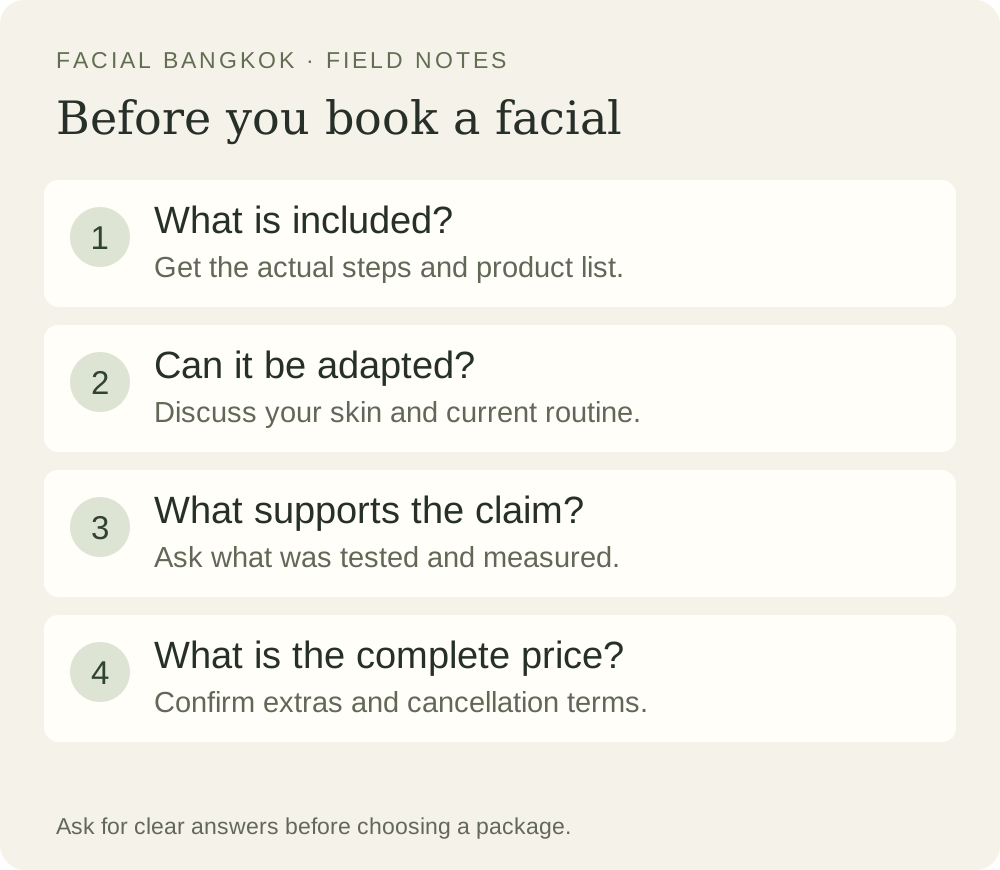
Send a short message: “I want a gentle cleansing and hydration appointment. Please confirm the products, exfoliation steps, whether the protocol can be adjusted, and the complete price.” Add any current symptoms and relevant clinician advice. Ask which practitioner will assess suitability before the treatment begins.
Use our Bangkok facial price guide to compare inclusions rather than treating the headline price as the final bill. Check consultation time, optional boosters and cancellation terms. For visitors, leave flexibility around the journey and avoid choosing a distant venue solely because its menu promises a pollution detox.
A useful plan for a short Bangkok stay
Before arriving, photograph the labels of products you already use and save any relevant aftercare instructions from recent treatments. Keep your first booking flexible until you know how your skin feels. A visitor does not need a special pollution package simply because they have spent a day sightseeing.
At the venue, ask the practitioner to repeat the agreed goal before beginning. If the suggested protocol changes, request an explanation and a revised total. Afterwards, write down which products were used and any instructions you received. This gives you something concrete to discuss if you book again or need professional advice.
For residents considering regular appointments, judge the first session by communication, comfort and whether the promised inclusions were delivered. You can decide about frequency later. A seasonal air-quality warning should not force an immediate commitment to a prepaid treatment course.
The practical approach is modest: monitor current air-quality advice, keep everyday care manageable and choose a facial for clearly described cosmetic goals. A thoughtful consultation and comfortable skin are better reasons to book than a promise to reverse a week of Bangkok air.
Sources, reporting date and scope
Researched on 16 November 2026 using The Nation's 15 November report, the 2025 Annals of Dermatology review, WHO guidance and the AAD resources linked above. The news describes a dated alert; it is not a continuously updated air-quality bulletin. Treatment comparisons and booking questions are editorial guidance. No venue visit, product test or medical review was conducted for this article. The hero is AI-generated; both diagrams are original editorial graphics. The embedded video remains hosted by YouTube.
FAQ
Can a facial remove PM2.5 from my skin?
A cosmetic facial can include surface cleansing, but that does not establish that it removes all fine particles or reverses biological effects of exposure. Ask what the provider means by its claim.
Should I wash my face more often on polluted days?
The AAD generally advises washing morning and evening and after heavy sweating. Avoid adding abrasive scrubbing or repeated cleansing simply because an air-quality alert has been issued.
Is HydraFacial an anti-pollution treatment?
A HydraFacial appointment should be assessed by its actual cleansing, exfoliation and hydration steps. A device name alone is not evidence of protection against pollution. Confirm suitability and the exact protocol before booking.
When should I postpone a cosmetic facial?
If your skin remains uncomfortable, products sting or you have unexplained symptoms, seek qualified advice before an elective cosmetic appointment. Tell the provider about recent procedures and any treatment plan you already follow.